
Notes on Craft: Coding continued and configuration development
October 2026
One of the aims for this blog has always been to share the messy middle of realist research and there is nothing more messy than the coding process. Feedback from our September blog had us considering the overlaps between coding for a review versus coding for an evaluation. Whilst this series has predominantly focused on how to approach secondary data, many of the lessons can be transferred, in true realist style, onto primary data too. Indeed, in just a few months’ time we’ll be repeating this process with evaluation data ourselves.
This blog which is our longest one yet continues our notes on coding, taking a more holistic view of data, particularly qualitative, whether that’s research papers, grey literature or other document types including qualitative interview transcripts (part one). We also begin to share some insights around tentative configuration developments too, because rarely are coding and configurations isolated from one another (part two).
Part one: Coding continued
Abstraction is really important to the coding process. The purpose of abstraction is to enable synthesis and pattern development. Your process needs to allow grouping of evidence across multiple sources. Keeping data too granular would lead to too many separate configurations with limited explanatory power. This is essentially what we mean when we say ‘middle range’.
The process of coding needs to involve actively looking for where else similar points appear across papers. Eventually you will bring each body of evidence together to reflect a configuration so keep iterating between paper-level meaning and potential configuration-level meaning.
Like all research that involves iteration, you may need to be prepared to group and re-label concepts and codes where this better reflects the overall pattern in the evidence. This doesn’t mean you’ve done anything wrong prior.
Mechanisms are inherently abstracted constructs and cannot be directly observed; they are inferred through patterns in the data. Continue to keep a tab on whether mechanisms are indeed those hidden and underlying processes that are unfolding within the context and are working to produce the outcome/s.
Context and outcome may be more visible in papers but still require clustering and interpretation.
Consider coding positive and negative data within the same bucket to retain relationships and contrasts. There is no need to artificially separate concepts if it obscures how they interact.
Use emerging patterns to decide whether contradictory data become standalone configurations or part of narrative explanations.
Recognise that not all data will produce a full CMO; partial insights still contribute to explanation building.
Part two: Developing configurations
At a certain point you may stop seeing a new configuration from every paper. Here, try to build and reuse configurations across papers.
You do not need to capture all detail in a single CMO statement; focus on clarity and transferability. Configurations need to be specific enough to accurately reflect what the evidence is showing, but general enough to allow a coherent narrative across studies. The detailed nuance does not sit within the configuration statement itself because it can be unpacked in the narrative that accompanies it.
The reason for clustering/ grouping evidence is because ultimately, you are working towards a place where each configuration created is supported by multiple sources. This might look like two to four (or more, depending on your data set) documents expressing similar patterns. Whilst in our September blog we encouraged you to generate tentative statements per paper/ document, this was just to build up a bank of patterns. As your end goal, it is generally best to avoid generating configurations from single papers for your final middle range theories because this may provide an insufficient basis for inference.
Try to ensure that, whilst we all have our lenses through which we view the world, a reader could go back to the cited papers and plausibly recognise the pattern being claimed.
A note on conceptually thick Vs thin data
There can sometimes be a usefulness to classifying papers as conceptually thick or thin. Thickness can be judged by the extent to which documents contribute explanatory insight rather than by study design or volume of text. Existing conceptualisations of thick and thin evidence may be used as a starting point, but project-specific definitions may ultimately be more useful.
Thin papers still contribute; they may support parts of a configuration (context, mechanism, or outcome) even if not a full CMO.
Assess papers based on explanatory contribution towards the programme theory.
Alankrita’s reflections:
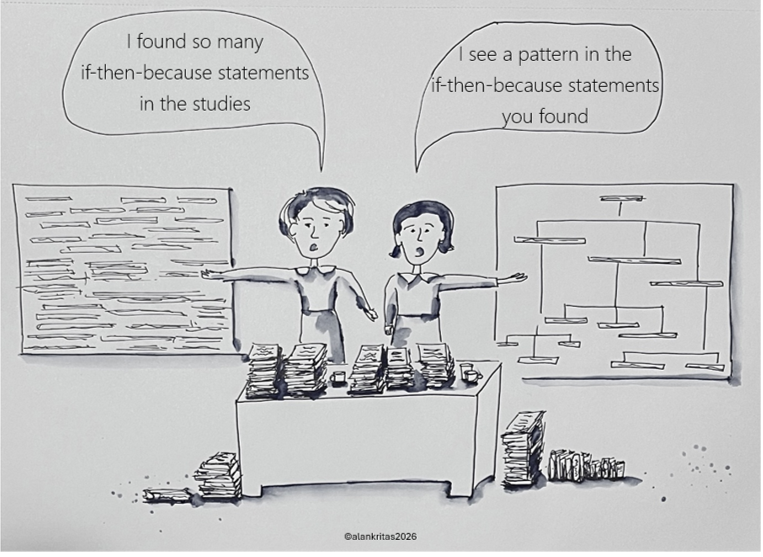
Finding the right balance between abstraction and granularity has been one of the most challenging parts of the coding process. Working so closely with the data, every relevant detail felt important to me. I was inclined to hold on to what everything I identified in individual papers. Letting go of that detail felt like missing out and was not easy.
Over time, however, I came to see that abstraction is essential for synthesising evidence and identifying patterns across studies. What helped was recognising that important details are not lost. Instead, they can be retained through exemplar data that sit alongside and support the more abstracted configurations.
Working as a team was also invaluable. Immersed in the data, it was often difficult for me to step back and see the bigger picture. Ruth, with a bit of distance from the data, and wider experience was often able to identify broader patterns, helping to develop configurations that could support meaningful synthesis.
One useful resource: Pearson et al, Table 2 for the articulation of conceptually thick/ thin contributions to data.
If citing this blog, please do so as: Abrams R and Singh A. Notes on craft: Coding continued and configuration development October 2026.


nice